Why Am I Not Getting Calls from Google?
Getting found on Google as a tradesman in the UK is the reason some phones ring all day and others stay silent. If yours is quiet, the problem is almost never the quality of your work. It is almost always a few fixable gaps in your online presence that your competitors have sorted out and you have not. This article explains exactly what those gaps are and what to do about them.
TL;DR: Your phone is quiet because your Google Business Profile is incomplete or unoptimised, you have too few reviews, your website is thin or missing, and your business details are inconsistent across the web. Fix those things in the right order and the calls start coming.
Table of Contents
- What is local SEO for tradespeople and why does it matter?
- Why is your business not showing up on Google?
- The Google Map Pack: the three spots that get the calls
- The five most common reasons tradespeople do not rank
- How to fix it: the right order to tackle the problems
- How long does it take to get results?
- FAQ
What is local SEO for tradespeople and why does it matter?
Local SEO (Search Engine Optimisation) is what determines whether your business appears when someone types “plumber in [your town]” or “electrician near me” into Google. It is not about paid adverts. It is about earning your place in the organic results and, more importantly, in the Google Map Pack. For tradespeople, local SEO is not optional. According to BrightLocal’s 2025 Local Consumer Review Survey, 98% of consumers used the internet to find a local business in the past year. Most of those searches started on Google, and most of those searchers called one of the first three names they saw. If your business is not one of those three names, the call goes elsewhere.
Why is your business not showing up on Google?
There is no single reason. Google decides which businesses to show based on three factors: relevance (does your business match what the person searched for?), distance (how close are you to the searcher?), and prominence (how well-known and trusted is your business online?). You cannot control distance. But you can control relevance and prominence, and most tradespeople have not.
The Google Map Pack: the three spots that get the calls
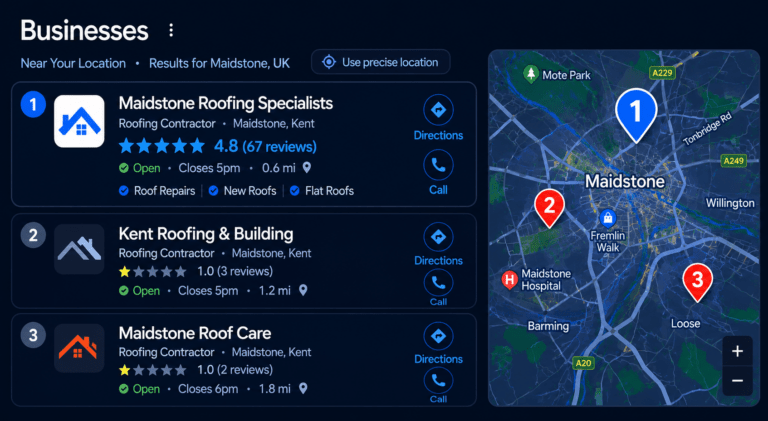
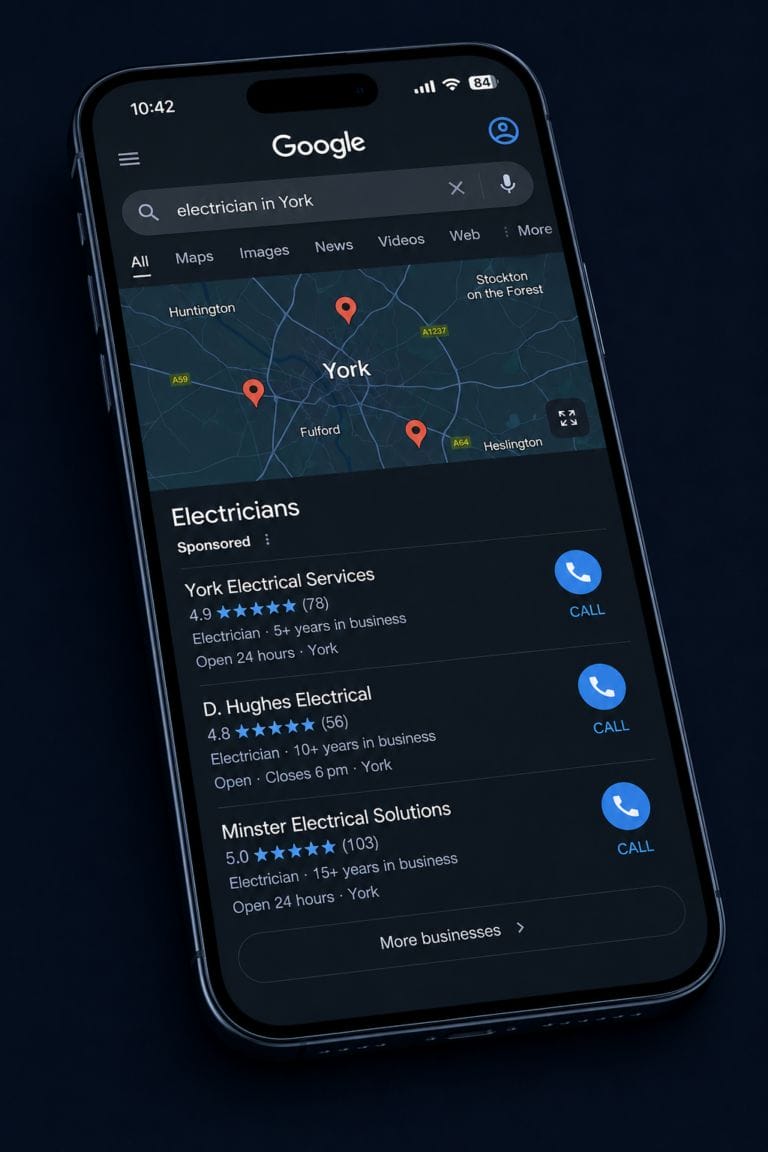
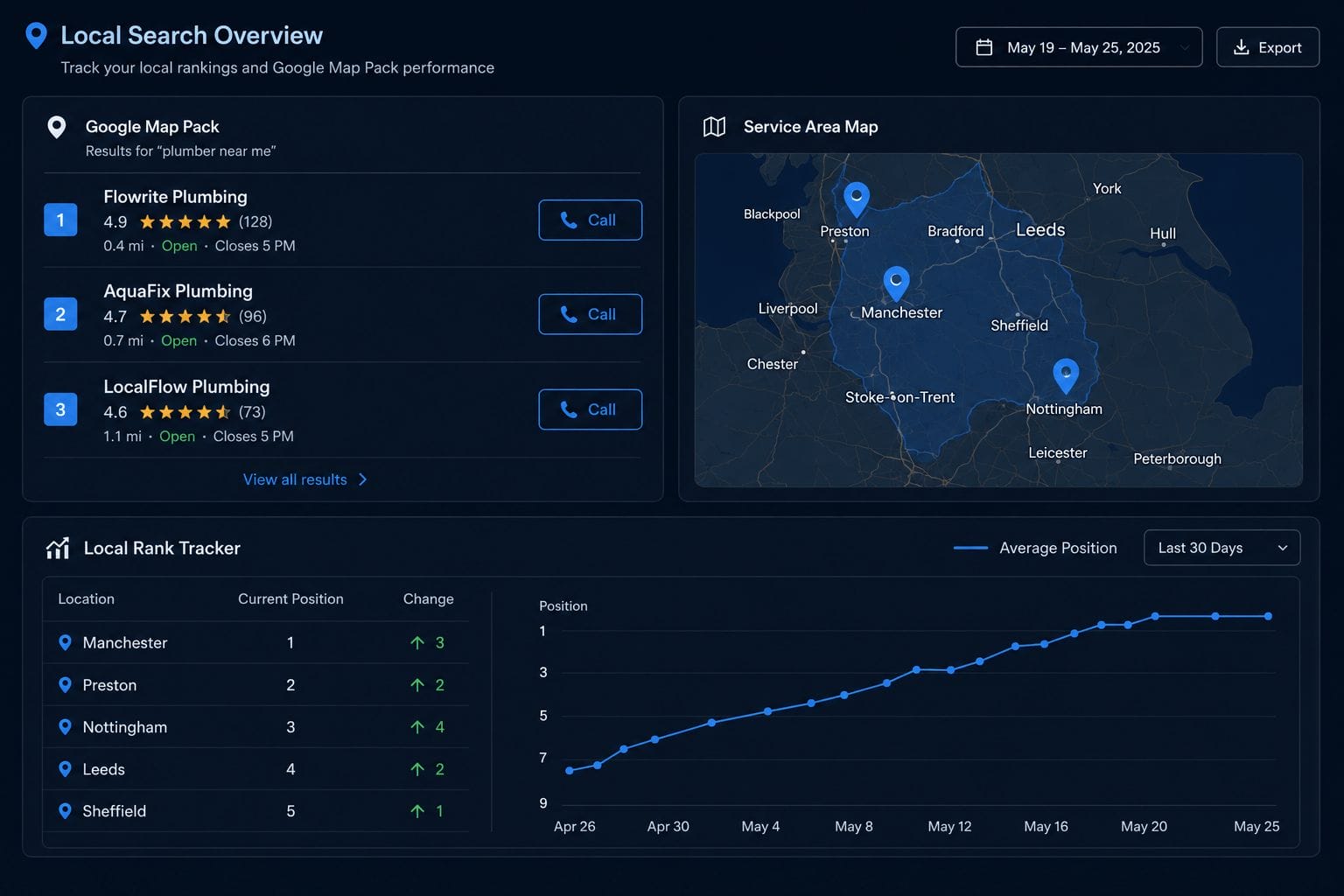
When someone searches for a trade service in a specific area, Google shows a box of three local businesses before the organic results. This is the Google Map Pack (also called the Local Pack). The businesses in those three slots receive the vast majority of clicks and calls from that search. Getting found on Google as a tradesman UK means getting into the Map Pack. It is not about paying Google. It is about having a properly optimised Google Business Profile (GBP), a good volume of genuine reviews, a website that confirms your services and location, and consistent business information across the web. If you are not in the Map Pack for your main service and town, you are invisible to most of your potential customers.
The five most common reasons tradespeople do not rank
1. Your Google Business Profile is incomplete or not optimised
A Google Business Profile that is claimed but not filled in properly barely registers with Google. Missing service categories, no description, no photos, no posts, and no regular activity all signal to Google that this is not an active, reliable business. Your GBP needs to be complete: every category ticked, every service listed, photos updated regularly, and your NAP (Name, Address, Phone Number) matching exactly what appears on your website and across every directory you are listed on.
2. You do not have enough Google reviews
Reviews are one of the most powerful local SEO signals. A business with 60 reviews averaging 4.8 stars will consistently beat one with 8 reviews averaging 5 stars. Not because it sounds better, but because Google sees those 60 reviews as strong evidence that real customers have used and trusted this business. Most tradespeople have done hundreds of jobs. They just do not have the reviews to show for it because they never had a system to collect them.
3. Your website is missing, thin, or not built for local search
Google uses your website to understand what you do, where you do it, and whether you are a credible business. A website with one page, no mention of the towns you cover, and no service-specific content gives Google almost nothing to work with. A properly structured trade website has individual pages for your main services, pages targeting each town or area in your patch, and content that clearly establishes your location and what you offer.
4. Your NAP is inconsistent across the web
NAP stands for Name, Address, and Phone Number. Google cross-references this information across dozens of directories, platforms, and websites. If your business name appears slightly differently on Yell, Checkatrade, and your website, or if your phone number has changed and some listings still show the old one, Google loses confidence in your business as a clear, real-world entity. Consistent NAP across 40-plus directories is a foundational local SEO signal. Most tradespeople have never done this work.
5. You have no content that answers your customers’ questions
Google’s algorithm is increasingly focused on E-E-A-T: Experience, Expertise, Authoritativeness, and Trustworthiness. For a trade business, this means publishing content that demonstrates you know your trade, answers the questions your customers are actually searching for, and covers the areas you serve. Four blog posts per month targeting local search terms builds ranking authority steadily over time. Without any content, you are relying entirely on your GBP and reviews, which limits how far you can climb.
How to fix it: the right order to tackle the problems
Tackle these in order. Each step builds on the last.
- Verify and complete your Google Business Profile. Fill in every section. Add photos. Write a clear description using the services and areas you cover.
- Sort your NAP consistency. Get your business listed on the main UK directories (Yell, Checkatrade, 192.com, Bing Places) with identical details on every one.
- Build or overhaul your website. You need service pages, area pages, and a site structure that tells Google clearly what you do and where.
- Set up a review collection system. A simple automated text to customers after each job, with a direct link to your Google review form, collects reviews without you having to ask awkwardly.
- Publish regular content. Four posts a month targeting the questions your customers search for builds your authority on Google steadily. Within six months, you will rank for terms your competitors are not even trying for.
How long does it take to get results?
Most clients see their first new Google reviews within two to three weeks. Map Pack visibility in their primary service area typically improves within four to eight weeks of completing the foundational work. Ranking across a broader service area takes three to six months of consistent activity. Local SEO is not instant. But it is compounding. Every review, every piece of content, and every citation makes the next result easier to achieve. The tradespeople who commit to it for six months end up in a position their competitors cannot replicate quickly.
FAQ
Why does my competitor show on Google Maps but I do not?
Your competitor has almost certainly done one or more of the following: fully completed their Google Business Profile, collected a good number of reviews, built a website with local content, and got their business listed consistently across directories. Google rewards active, well-evidenced businesses. The good news is that this is fixable.
Do I need a website to get found on Google?
You can appear in Google Maps without a website, but your ability to rank competitively is severely limited without one. Google uses your website to understand your services and coverage area in depth. Without a site, you are leaving most of the ranking signals on the table.
How many Google reviews do I need?
There is no magic number, but in most UK trade markets, businesses in the Google Map Pack have at least 30 to 50 reviews. More importantly, you need to be collecting reviews consistently. A business that is actively gathering reviews signals to Google that it is trading actively and satisfying customers.
What is NAP and why does it matter for local SEO?
NAP stands for Name, Address, and Phone Number. Google cross-checks your business details across the web. Inconsistencies confuse Google’s understanding of your business and reduce your local ranking authority. Getting your NAP consistent across major UK directories is one of the highest-return fixes you can make.
Can I do this myself or do I need help?
Some of it you can do yourself: claiming and completing your GBP costs nothing but time. Building a properly structured website, managing citations across 40-plus directories, and publishing consistent content every month is where most trade business owners run out of hours. That is where a managed service makes sense.
How much does local SEO cost for a tradesperson in the UK?
Managed local SEO for tradespeople in the UK typically costs between £200 and £500 per month on a retainer, with some providers charging a one-time setup fee to build the foundations. DIY approaches can work but take significantly longer and require consistent effort to maintain.
Will local SEO work in a competitive area?
Yes, but it takes longer. In highly competitive urban markets, the businesses at the top of the Map Pack have usually been building their online presence for years. Starting now means you are building compounding authority. The alternative is staying invisible while they pull further ahead.
If your phone is quiet, it is almost certainly not because there is no work in your area. It is because the customers searching for what you do are finding someone else first. Getting found on Google as a tradesman in the UK is a solvable problem. The fixes are not complicated. They just need to be done properly and consistently.
Book a free 20-minute call. We will look at where your business currently sits on Google, tell you what is holding you back, and explain exactly what we would do about it. No hard sell. No obligation.