Why Is My Competitor Always at the Top of Google Maps?
The competitor top of Google Maps UK situation is one of the most common frustrations we hear from tradespeople: their phone is quiet, a rival appears at the top of the Map Pack every time, and no one has explained why. The reason is almost never the quality of your work. This post explains exactly what those signals are and what it takes to close the gap.
TL;DR: Your competitor ranks above you on Google Maps because they have a more complete Google Business Profile, more reviews, a better-structured website, and consistent business listings across the web. All of these are fixable. None of them require technical expertise to understand.
Table of Contents
- What is the Google Map Pack?
- Why does my competitor rank above me on Google Maps?
- The five signals Google uses to decide who shows up
- What your competitor is probably doing that you are not
- How to close the gap on Google Maps
- How long does it take to move up?
- FAQ
What Is the Google Map Pack?
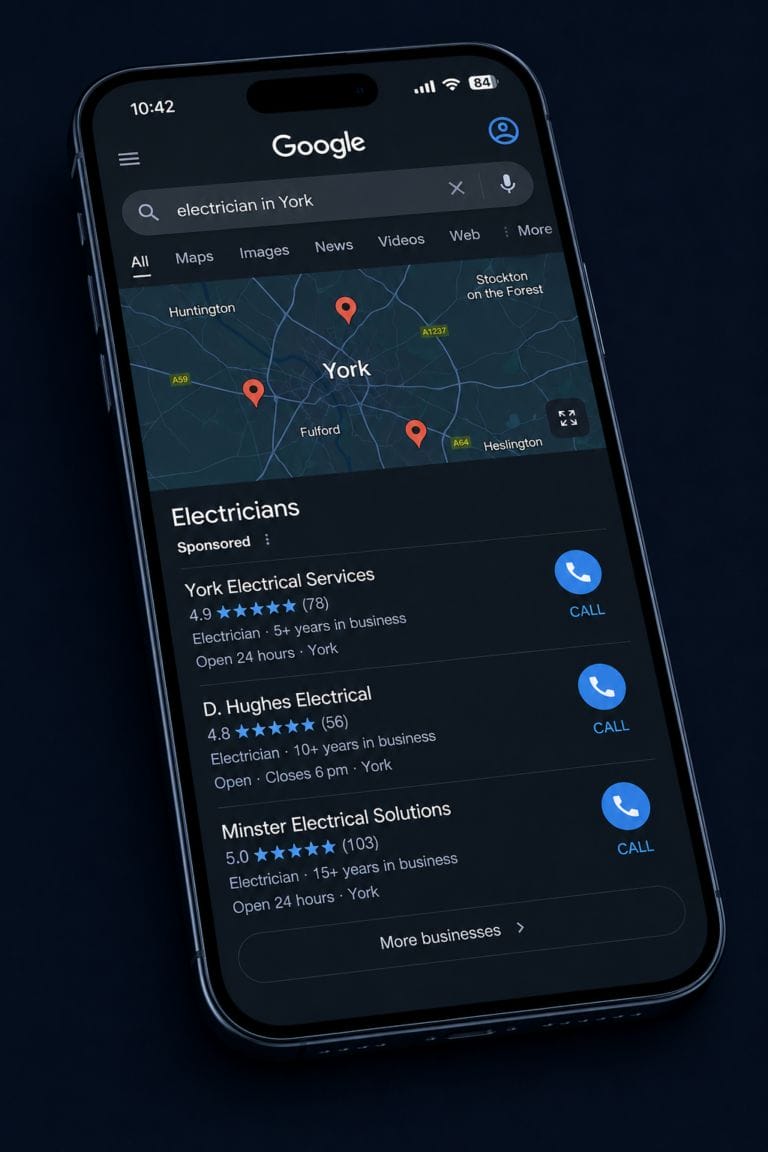
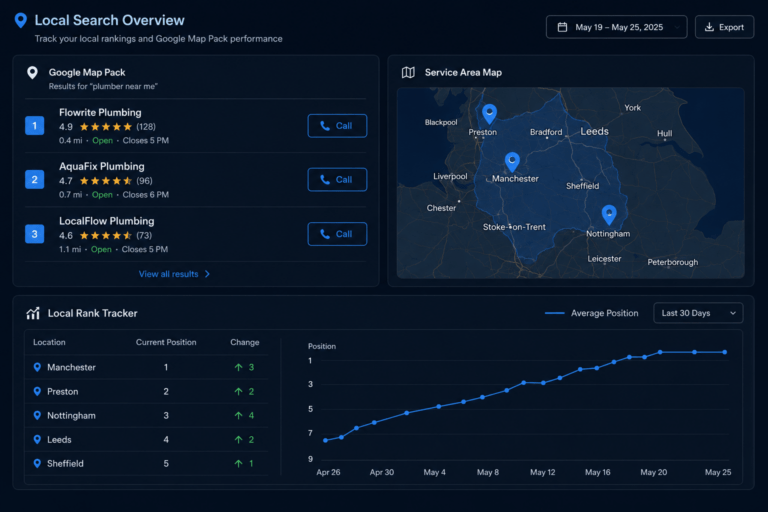
When someone searches “electrician in [your town]” on Google, the first thing they see is a box of three local businesses before any website results. This is the Google Map Pack, sometimes called the Local Pack. Those three spots receive the vast majority of clicks and calls from that search. If your competitor is in the box and you are not, they are collecting work that could have been yours. Google fills those three spots based on its own assessment of which local businesses are the most relevant, most trusted, and most prominent for that search. That assessment is not random, and it is not fixed.
Why Does My Competitor Rank Above Me on Google Maps?
Google judges local businesses on three factors: relevance (does your business match what the person searched for?), distance (how close are you to the searcher?), and prominence (how well-known and trusted is your business across the web?). You cannot move closer to every potential customer. But you can become significantly more relevant and prominent, and that is almost certainly where the gap sits. The competitor top of google maps UK problem is usually not about budget or luck. It is about who has done the groundwork.
The Five Signals Google Uses to Decide Who Shows Up
1. Google Business Profile completeness
A Google Business Profile that is claimed but not filled in properly gives Google very little to work with. Missing service categories, no photos, no description, and no regular activity all tell Google this is a dormant listing. A fully built-out profile covers every service category, includes a detailed business description, has photos updated regularly, and shows your Name, Address, and Phone Number (NAP) matching exactly what appears on your website.
2. Review volume and recency
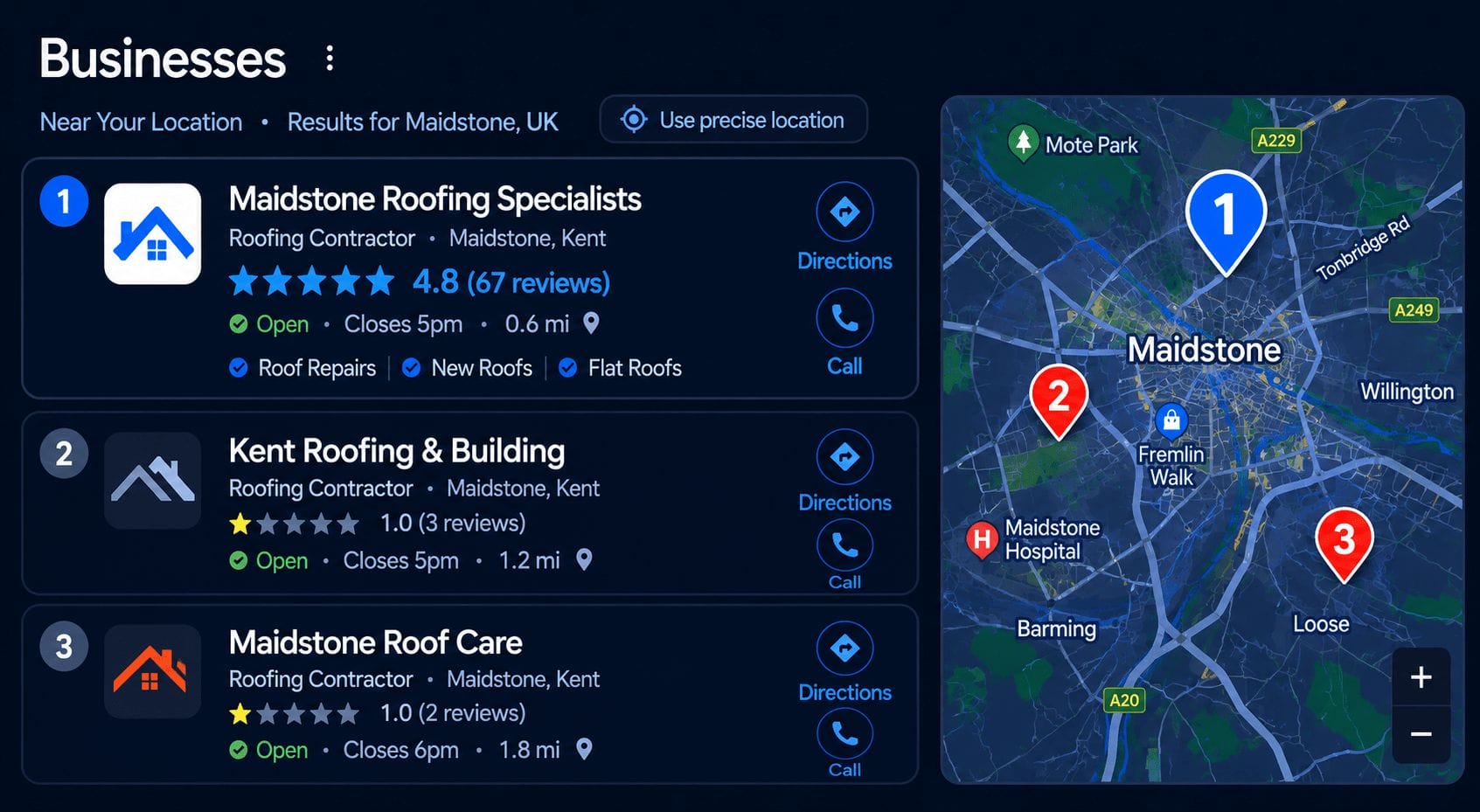
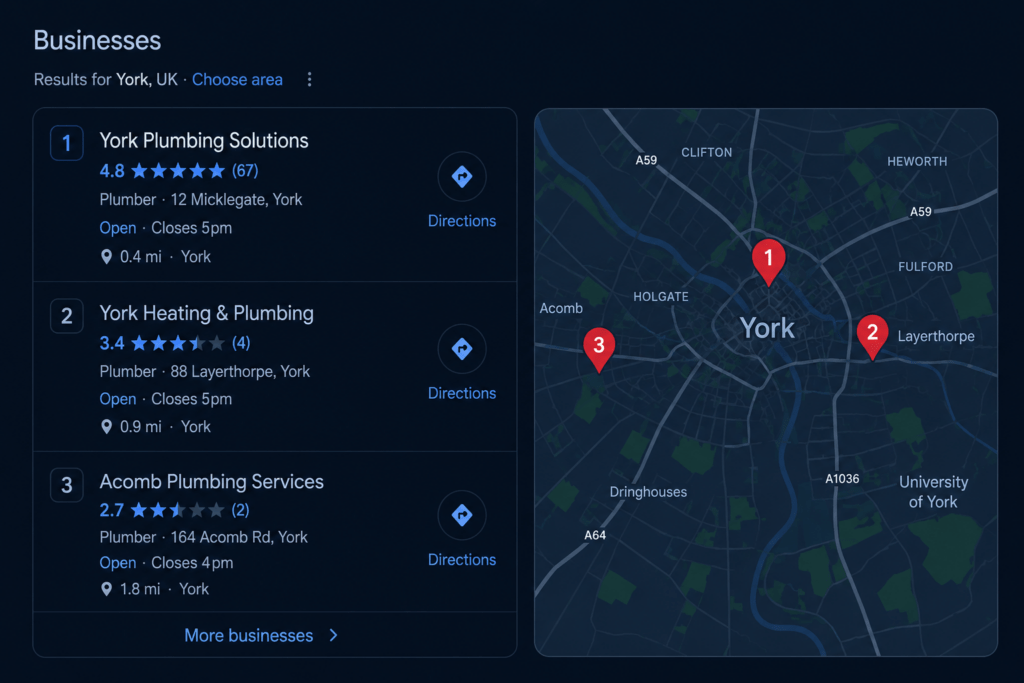
Reviews are one of the most powerful signals in local search. According to BrightLocal’s 2025 Local Consumer Review Survey, businesses with more reviews and a higher average rating consistently appear above those with fewer. A business with 45 reviews and a 4.7 rating will typically outrank one with 12 reviews and a 5.0 rating. Volume and recency matter more than perfection. If your competitor is collecting reviews consistently and you are not, the gap widens every week.
3. Website quality and local content
Google uses your website to understand what you do and where you do it. A one-page site with no mention of your service towns tells Google almost nothing about your coverage area. Your competitor probably has individual pages for each main service and pages targeting the towns they cover. Each of those pages is an additional ranking signal that confirms to Google they are an active, relevant business in that area.
4. NAP consistency across directories
Google cross-checks your business details across dozens of UK directories. If your name, address, or phone number appears differently on Yell, Checkatrade, and your Google Business Profile, Google loses confidence in your business as a clearly defined entity. Consistent NAP across 40-plus directories is a quiet but persistent ranking advantage. Most tradespeople have never done this work.
5. Engagement signals
Google pays attention to what happens when your listing appears in search results. Click-through rate, direction requests, and calls all tell Google your listing is useful and relevant. A competitor who appears more often and gets clicked more often builds an engagement advantage over time. This is another reason early investment in the foundational signals matters: it starts a compounding cycle.
What Your Competitor Is Probably Doing That You Are Not
You can check this in five minutes. Search for your main service in your town. Find the business at the top of the Map Pack. Then look at:
- How many reviews do they have compared to you?
- How recently were their last reviews posted?
- Do they have photos on their Google Business Profile?
- Do they have a website with multiple service and area pages?
In most cases, the answer to all four is “more than you.” Not because they are better at the work. Because they have built their online presence and you have not yet.
| Signal | Typical top-ranking business | Typical mid-ranking business |
|---|---|---|
| Google reviews | 40 to 80+ | Under 20 |
| Profile completeness | Full: categories, photos, posts | Claimed but minimal |
| Website pages | 10 to 30+ | One or two pages |
| Directory listings | Consistent across 40+ sites | Inconsistent or missing |
How to Close the Gap on Google Maps
The gap is fixable. It requires doing the foundational work in the right order.
- Audit and complete your Google Business Profile. Fill in every section. Select every relevant service category. Add photos. Make sure your NAP matches your website exactly.
- Start collecting reviews consistently. A simple automated text after each job, with a direct link to your Google review form, collects reviews without you having to ask awkwardly.
- Build or overhaul your website. You need at least one page per main service and a page for each area you cover.
- Tidy your directory listings. Get your details consistent across Yell, Checkatrade, 192.com, Bing Places, and the other main UK directories.
- Publish regular content. Four posts a month targeting the questions your customers search for builds your authority steadily over time.
For a full breakdown of the fixes in order, read our guide on getting found on Google as a tradesman in the UK.
How Long Does It Take to Move Up?
Map Pack movement typically starts within four to eight weeks of completing the foundational work: a fully built-out Google Business Profile, a properly structured website, and consistent directory listings. Reviews compound over time. The first ten arrive slowly. Once you have thirty or forty, Google treats your business as clearly active and trusted, and the pace of ranking improvement accelerates. Ranking across a full service area, rather than just your primary town, takes three to six months of consistent effort. Local SEO is not instant. But once you are in the top three for your main searches, maintaining that position is much easier than getting there.
FAQ
Why does my competitor have more reviews even though I have been trading longer?
Almost always because they have a system for collecting them and you do not. Most tradespeople do excellent work and never ask for a review. Your competitor probably sends an automated message after each job. Over time, that difference compounds into a significant gap on Google Maps.
Can I report a competitor if I think they are using fake reviews?
Yes. If you suspect fake reviews or a misleading business address, you can flag their profile directly in Google Maps using the “Suggest an edit” or “Report a problem” options. Google investigates these reports, though it can take time.
Does running Google Ads improve my Maps ranking?
No. Google Ads and organic Google Maps rankings are entirely separate. Running paid adverts does not improve your Map Pack position. The Map Pack is earned through profile optimisation, reviews, website signals, and directory citations.
What if I work across multiple towns? Can I rank in all of them?
Yes, but it takes time and the right structure. You need area-specific pages on your website, consistent directory listings for each area, and ideally some reviews mentioning specific locations. Your primary town will rank first. Others follow as your authority builds.
My Google Business Profile is set up. Why am I still not in the Map Pack?
A claimed profile is not the same as an optimised one. Google needs complete service categories, photos, regular posts, and a matching website before it starts ranking your listing competitively. Being claimed puts you ahead of businesses that have not claimed their profile, but still well below those who have done the full work.
How do I know if my NAP is inconsistent?
Search your business name and check how your details appear on the main directories: Yell, Checkatrade, 192.com, Thomson Local, and Bing Places. Any differences in your business name, address format, or phone number are inconsistencies that weaken your local ranking signals.
Is the Map Pack the same as paid adverts?
No. The three businesses in the Map Pack appear there because Google judged them the most relevant and trustworthy for that search. It costs nothing per click. The listings above the Map Pack, marked “Sponsored,” are paid adverts that businesses pay for each time someone clicks.
If your competitor is consistently at the top of Google Maps, they have done the groundwork. The gap is real, but it is not permanent. Every week that passes without action, they collect more reviews, more clicks, and more authority.
Book a free 20-minute call. We will look at exactly where your business sits compared to your local competitors, show you what they are doing that you are not, and explain what it would take to close the gap. No hard sell, no obligation.