How Do Customers Find Tradespeople in 2026?
How customers find tradespeople has changed more in the last ten years than in the previous fifty, and the shift is now complete. The majority of people searching for a local tradesperson today start on Google, not on a neighbour’s recommendation, not on a directory, and not on a leaflet through the door. This post breaks down the data and explains what it means for your business.
TL;DR: In 2026, most customers find tradespeople through Google Search and Google Maps. Word of mouth still matters, but it has moved online: it shows up as reviews, not phone calls to a friend. If your business is not visible on Google, you are invisible to the majority of customers actively looking for what you do.
Table of Contents
- How customers used to find tradespeople
- How customers find tradespeople now
- The three moments when customers search for a tradesperson
- What types of searches customers make
- What reviews have replaced
- What this means for your business
- FAQ
How Customers Used to Find Tradespeople
Ten years ago, most people found a tradesperson through a direct recommendation from a neighbour, a family member, or a colleague. Word of mouth was the dominant channel. A plumber built their business one satisfied customer at a time, and those customers passed the name along.
Directories played a role too. Yell, Thomson Local, and trade-specific platforms like Checkatrade gained traction in the early 2010s. Leaflet drops, van signage, and local newspaper ads rounded out the picture.
All of those channels still exist. None of them are the primary way customers find tradespeople today.
How Customers Find Tradespeople Now
The primary channel is Google. According to BrightLocal’s 2025 Local Consumer Review Survey, 98% of consumers used the internet to find a local business in the past year. For most of those searches, the journey started and ended on Google.
The numbers behind local search tell the same story. An estimated 46% of all Google searches have a local intent, meaning the person is looking for something in a specific place. And 76% of people who perform a local search on a mobile phone visit or contact a business within 24 hours.
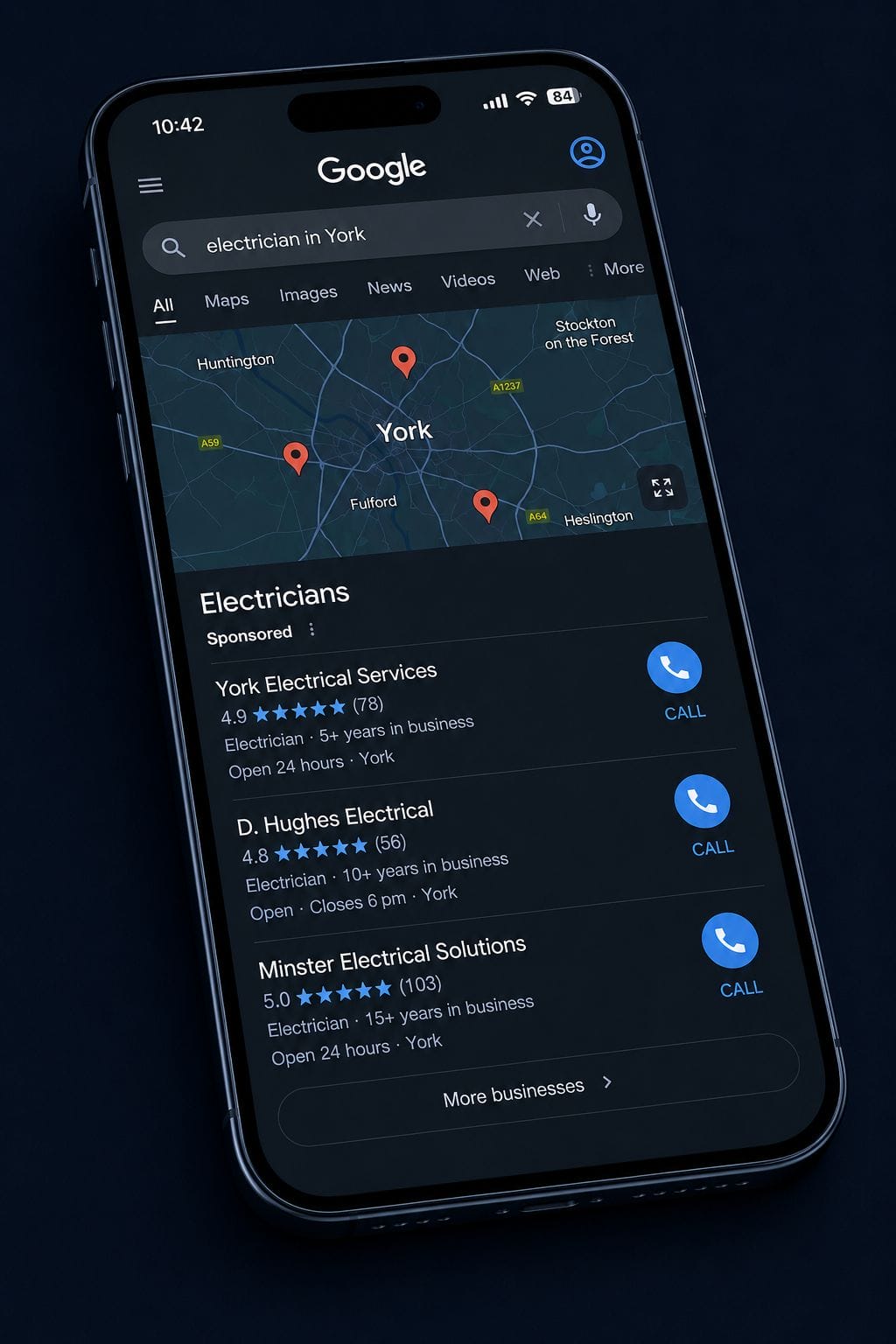
Customers are not browsing. They are searching with intent. When someone types “emergency plumber in [town]” into Google, they want to call someone within the next few minutes. The business that appears first gets that call.
The Three Moments When Customers Search for a Tradesperson
Not all searches happen the same way. Understanding why a customer is searching helps explain what they find.
The urgent search. A pipe has burst, a boiler has gone out, an alarm is sounding. The customer reaches for their phone and types the first thing that comes to mind. They call the first business with good reviews that appears in Google Maps. Speed of response and visibility in the Map Pack are the only factors that matter here.
The planned search. The kitchen needs a refit. The driveway needs new block paving. The customer is not in a rush, but they are genuinely looking. They might check three or four businesses, read reviews, and look at websites before calling. This is where your Google Business Profile, your review count, and your website all work together.
The referral check. Someone has recommended a tradesperson by name. Before calling, the customer Googles the name to check reviews and confirm they look legitimate. If your Google Business Profile looks abandoned and you have fewer than ten reviews, the referral may call someone else instead.
What Types of Searches Customers Make
Most searches fall into one of two patterns.
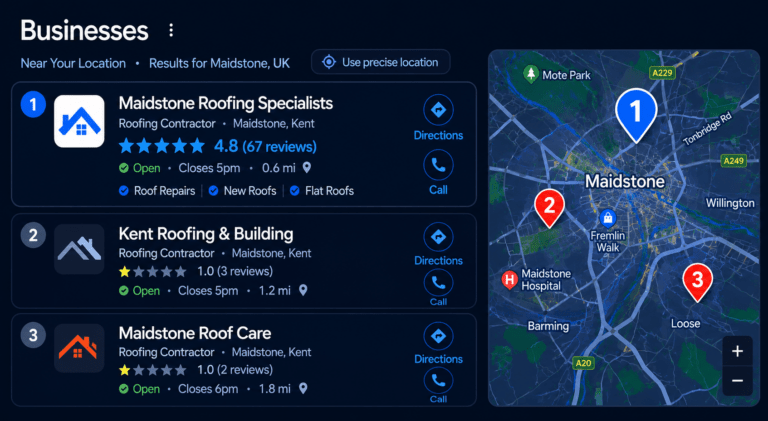
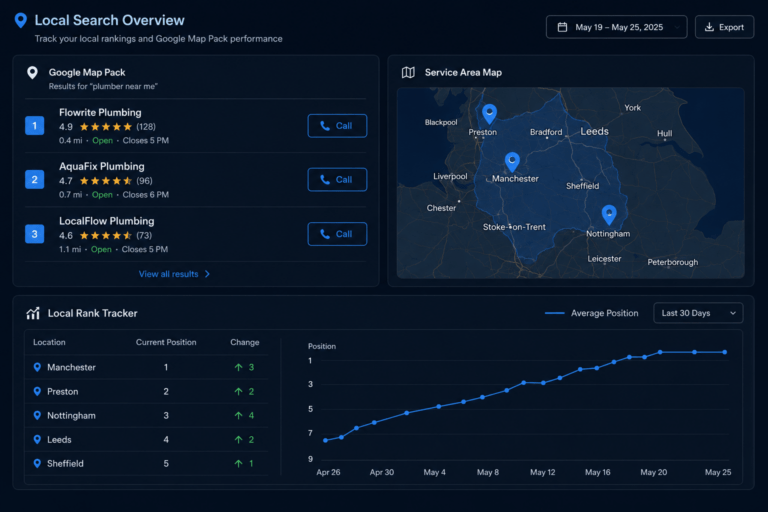
Service plus location. “Electrician in Stockport.” “Heating engineer near me.” “CCTV installer Manchester.” These are high-intent searches where the customer already knows what they need and where they are. Google responds with the Map Pack: three local businesses, ranked by relevance and trust signals.
Problem searches. “Boiler making noise,” “who to call if a pipe bursts,” “how much does a new driveway cost.” These searches land on websites, not Maps listings. A trade business with a blog covering these questions builds ranking authority and captures customers earlier in their decision-making.
Both types matter. The Map Pack captures customers who are ready to call now. Blog content captures customers who are still deciding.
What Reviews Have Replaced
Word of mouth has not disappeared. It has moved online.
A recommendation from a neighbour used to come in a phone call or over a garden fence. In 2026, it comes in the form of a five-star Google review. When a customer leaves a review saying “Dave sorted our boiler same day, brilliant service, highly recommend,” that recommendation is now visible to everyone searching for a heating engineer in that area.
The difference is scale. A traditional word-of-mouth recommendation might reach five or ten people over the course of a year. A Google review with that same message is visible to everyone who searches in your area, every day, indefinitely.
Businesses that are collecting reviews consistently are effectively amplifying their word of mouth across every search. Businesses that are not are leaving that channel empty.
What This Means for Your Business
The customers are searching. The question is whether they are finding you or someone else.
If your Google Business Profile is incomplete, your reviews are sparse, and your website does not mention the towns you cover, you are not visible to the majority of customers actively looking for a tradesperson in your area. Those customers are not calling no one. They are calling your competitor.
The fixes are straightforward: a fully built-out Google Business Profile, a consistent flow of reviews, a website structured around your services and areas, and content that answers the questions your customers are searching for. For a full breakdown of where to start, read our guide on getting found on Google as a tradesman in the UK.
If you want to understand why a specific competitor keeps appearing above you, this post explains what they are probably doing differently.
| Channel | How customers used it (2010s) | How customers use it now |
|---|---|---|
| Word of mouth | Direct personal recommendation | Google reviews seen by all |
| Directories | Yell, Thomson Local, printed | Google Maps, Google Business Profile |
| Websites | Nice to have, rarely visited | Checked before calling |
| Social media | Barely used for trades | Job posts, recommendations, reviews |
| Leaflets and ads | Meaningful reach | Largely ignored |
FAQ
Is word of mouth still worth anything for tradespeople?
Yes, but its value has changed. A direct personal recommendation is still one of the strongest reasons a customer will choose you. The difference is that the recommendation now leads to a Google search rather than a phone call. If your Google presence does not back up the recommendation, you can lose the job even when you were already the preferred choice.
Do customers still use directories like Checkatrade or Yell?
Some do, particularly older customers or those with specific concerns about vetting. But the volume of searches that start on Google far exceeds those that start on a directory. Being listed on Checkatrade or Yell is still worth doing, primarily because consistent directory listings strengthen your Google Maps ranking rather than because the directory itself drives significant lead volume.
How important are reviews to how customers find tradespeople?
Very important, and in two ways. Reviews directly influence your ranking in Google Maps, meaning more reviews helps more customers find you in the first place. They also influence whether customers choose you once they have found you. A business with 50 genuine reviews will consistently win more calls than one with 8, even if the quality of work is identical.
Do customers look at a tradesperson’s website before calling?
For urgent searches, often not. For planned work, almost always. Before committing to a quote or a call for a larger job, most customers will visit your website to check that you look like a legitimate business, confirm your service area, and read more about what you offer. A thin or outdated website loses jobs at this stage.
Are younger customers finding tradespeople differently to older ones?
The method is similar (Google search on a mobile phone), but younger customers rely more heavily on reviews and place more weight on recent reviews than older customers tend to. They are also more likely to judge credibility from your Google Business Profile photos and your website quality. The fundamentals are the same: show up on Google, have good reviews, look like an active business.
How do customers decide which tradesperson to call?
After finding a shortlist through Google Maps, most customers look at three things: review count and average rating, how recently the reviews were posted, and whether the business looks active (photos updated, Google Business Profile posts visible). A business with 40 reviews, a 4.8 rating, and a recent photo of a completed job will typically win over one with 60 reviews but nothing posted in 18 months.
The customers looking for a tradesperson in your area are searching right now. The businesses appearing in those results are getting the calls. If you are not one of them, the starting point is the same for almost every trade business in the UK: fix the foundations, collect reviews, and build an online presence that reflects the quality of work you already do.
Book a free 20-minute call. We will show you exactly where your business stands in local search right now and what it would take to get you in front of the customers searching for your trade in your area. No hard sell, no obligation.